Wednesday, March 9, 2011

#12 -- "Final Fantasy IX" Reviewed | * * * *

"Final Fantasy IX is a videogame, meditating."

There's a difference between prolonged self-reflection and cowardice. Not risking anything can be a huge risk. You might stagnate. You might be accused of not caring, of beating a dead horse, or of trying to squeeze blood from a stone. Merely pretending to not take a risk though... that is a legitimate creativity Philosopher's Stone. Aha, and now we can venture into the realm of satire, a flexible form if executed well. It grants you the ability to toy with critics, lean on well-worn supports, bait, switch, lure, surprise, skew, skewer, parody, honor, celebrate, and prove your understanding of creativity's contents. If done correctly, that is. In the hive-mind that acts as the capitol city to What's That From?, Final Fantasy IX is universally recognized as the third best video game of all time, a position it's held for 11 years now. Here's why:
  1. The hero, Zidane, is every little boy's hero because he's like the older brother we all wish we had growing up. He's brash, kind, supportive, reckless, funny, and he's got a tail that helps him accomplish his shenanigans.
  2. The villain, Kuja, has the kind of teeth that every little boy would love to scatter across the deck of a wooden ship. He monologues. He's a little he-bitch.
  3. There's a moment when the love interest, Princess Garnet, might kill herself, but instead does something with a dagger you could never see coming.
  4. The music is sticky honey. It clings to the roof of your mouth and it summers in your heart's new-found unseasonable warmth. I want to ferment it into an alcoholic drink and then get smashed off of Final Fantasy IX's music 12 years from now.
  5. Its opening takes place during a kidnapping that uses a flying theater boat as a diversion.
Yes, the beginning. The beginning is a Muppets-doing-Shakespeare moment (complete with a sly reference that the play being performed on the night of the kidnapping is by one 'Lord Avon'). Then the story morphs into a swashbuckling version of Mission: Impossible before really getting down to business when your party of four traverses a forest that turns to stone, an then ice cave, and then finally a quiet hamlet with a windmill. We take a breather at the end of the first hour before finding out that our finally, officially kidnapped princess has her own plan, and the quiet hamlet has a dark secret.

The thing that makes the intro to this game so damn charming is that it roleplays how you or we would act in a roleplaying game. The flavor is set from your first bite. It knows if you were the hero, you'd know your role, winking and smiling at the camera while slathering the princess with amber-brown sappy charm. It knows the book-smart, but regal/clueless princess wouldn't react to any kind of charm -- her character is real enough to require time and proof of heroism in equal measures to be won over. It knows Vivi, our child-in-stature Black Mage, will be everybody's favorite character because he's friendly, in-touch, mildly-innocent, and is stronger in magic than his small body should allow. Seriously, he brings the hurt. Vivi is a Christmas bonus inked in at the bottom of your meager paycheck. Every game needs "FUCK YEAH!" moments, and with little Vivi dropping meteorites on the dragon that just incapacitated the princess, you get them in Final Fantasy IX right when you need them.

And the story knows this tale needs a condescending knight who is sworn to priggish-flavored chivalry, but earns back street cred with honest ass-kicking during those closer battles. Steiner is his name. He's a goof and his repartee with Zidane is fun to watch. There's a lot of tasteful Warner Bros. animation inside Steiner's character. In fact, all of the characters are so clearly conceived and drawn to be themselves that you will find yourself giddy waiting for each genre trope to rear its head. This is an exemplary demonstration of a story hitting the established notes. Rewinding back to the Muppets-doing-Shakespeare reference from a few paragraphs back, that guy knew how to do tragedy (or rip it off from Italian folk stories, but who's counting?). The best tragedies forecast an end to your characters' recognizable happiness. You show something familiar and potentially ordinary, which is precisely how Final Fantasy IX starts. Oh, there's an intelligent but naive princess! Oh, there's a rebel with a charming heart! Oh, and that little magician will be his sidekick! And that big, brick-shaped knight in rusted armor will be their moral compass! 

Dangle that in front of the player. Let them snuggle up the characters. Let them think they're in control and that they know how the story will go. Then, when the player falls, and assumes they'll be caught, let them fall. And they'll fall hard. 

Kuja arrives, face stained with rain, blinking at our heroes after they've fallen in a tough battle. He barely notices them. Saddling up on his pearlescent Portuguese Fuck-Dragon, his thunderstorm musical theme queues up. He exits. Disc 1 ends. 

It's a stunning turn. It's too early in the story to equate it to the deaths of Mercutio in Romeo and Juliet or Polonius in Hamlet -- which are famous for being gigantic sign-posts whose oozy-black words read : "the shit will continue to spill until all main characters die" -- but it's an act-ending turn nonetheless. It's here that Final Fantasy IX shifts from slow-burning 32-bit fairy-tale to an artistic-medium story-buster. A few things have happened:
  1. The bad guy has arrived. He is bad. So bad that we don't even know his name yet. And he ignored us.
  2. Our (our!) characters have come far, but they're coming off a tough loss, and we're left for dead in a massacred city in the rain.
  3. The bad guy is selling his stockpile of magical golems, living weapons to the princess' mother. For what reason? He's so supremely bad, this can't be all there is! What else? What else?!
  4. Our happy band of friends is scattered. The characters wonder aloud if those absent are worried about them.
  5. We, the player, have to get up off the couch, take a breath, and change discs to Disc 2. We miss this sensation. It is turning pages in a book you love. There's a certain physical/mental friction point that is engaged when this happens. Yes, you have to change the disc, and that is the only thing you want to do right now because you need to know what happens! It's the same feeling you get when you eat chicken wings, gnawing the meat off of the bones. It's the feeling of ending a chapter in a book, flipping the page, and seeing Act II: Wherein We Learn Of Villainy, and there's nothing but another turn of this weighty, frictious paper between you and Zidane's fate. "Get it out of my way," you growl. You leap off of your sofa, slam in Disc 2, and scramble back into your blanket-fort as the next scene fades in.
Act breaks are fun. There are too many of them on TV. We like shows on HBO and Showtime, mostly because there's swearing in them, and that makes them more real, but we miss the act breaks. We don't like ads, they tasteless intrusions into TV shows that we're already paying cable companies to see, but the emotional crescendo and comedic punchline come straight from act breaks, very important tools in storytelling, so when premium TV networks do full-hour shows, it feels, just, odd, you know? It's like a really long act in a play or a long chapter in a book, and the narrative can lose focus. Videogames had act breaks for a brief period in the form of the disc-change -- a lost art.
Sidebar: Final Fantasy VII, Final Fantasy VIII, and Final Fantasy IX have the best "end of Disc 1" moments in videogames. FF7 had Aeris' encounter with Jenova, FF8 had Squall stealing a car and getting stabbed by Edea, and FF9 had Kuja's arrival. All huge tonal shifts that wreak of a live theatricality missing from modern entertainment. The viewer is deliberately removed from the immersion and the story. Take a breath. And now we begin again.

BOOM! That feeling separating yourself from the story and collecting one's thoughts is rad as hell! It was sort of a phenomenon of the PlayStation 1 era of videogames because the discs were cheap and they could cram tons of CGI movies and spoken audio into games to help them sell to glassy-eyed pre-teen fuckwits back then. This is sort of lost now, and we miss it on occasion. 

Onward and downward. The story, formerly confined to the Mist Continent (yes, it's called that for that exact reason), expands. Your map is now just the lower corner of a much bigger map. The "oops, the world is way bigger," moment is also unique to videogames.

The game says, "You've only just begun." 
"Hell yes," is your reply. 

A detail that you've learned earlier is that despite the abundance of airships in Final Fantasy IX, they run on mist. Listen, there is no mist on these other continents and the oceans are filled with vicious monsters that eat ships. This is a Christopher Nolan-style detail nugget about the mist only being one continent and that it powers the airships. You forget about it when it's mentioned, but it ends up being a pretty key plot point during the third act. Oh, what, Batman mentions re-routing part of Wayne Industries' investments to wireless network development at the fifteen-minute mark of The Dark Knight?

BOOM! That cell-phone sonar location during the final battle with The Joker two hours later is rad as fuck!

Speaking of complexity, the gameplay in Final Fantasy IX is certainly not. You could almost play it with one button since the towns are filled with people you can press X to talk to or not press X to not talk to, and the battles are filled with monsters you can press X whack with your weapon of choice, be it dagger, sword, club, lacrosse stick, wolverine claw, spear, or fork. There are a lot of ways to tune your enemy's piano and some are immune or weak to this or that, and there's minor magic management. It's basic, it's sort of slow, and it's got great sound effects for when you enslicen a piece of bandersnatch off of that froth-mouthed freak-wolf. The game does this fun thing though where it will give you the chance to use new, stronger weapons or armor before you're done learning the abilities that are stapled to your older equipment. Spells et al are learned by wearing a helmet or whathaveyou but you'll most likely get a better one before you've worn it long enough for the character to fully absorb the ability. This results in some light juggling. It's infrequent, the system maintains its simplicity. The simplicity keeps with the game's relax-you theme. This is how it succeeds.

It's in the presentation, the music, the story, and the world. The magic of human-videogame interface is what makes the thing hum. It's a place you want to occupy and that's the metaphorical steeplechase that trips people up when they can't grasp the "why" of videogames as a medium "for" something. This game defies its digital upbringing. Final Fantasy IX has a point to make: games have come a long way. It's quite reflective, the more we think about it. This game isn't here to suck up your time. It isn't here to give you something to do, to capitalize on popularity, to one-up a competitor, or to boast. Final Fantasy IX is a videogame, meditating. Its deeper recesses are accessed when your right brain is left to focus on something methodical. For example, when you wash dishes, you might hum to yourself. It's a partly-made-up tune, mostly original, brought out by silencing a part of your brain that is often too noisy. 

While one part of your mind is left to run on muscle memory, what's left is the part that can think without interruption: "Wow! Just look at what's become of sprites and pixels." Self-reflective characters. Ornate, intricate worlds. Art, realized in its purposeful detailed twists. Similes within metaphors, external references, villains worth hating, motivations worth questioning, personal physicality being engaged when nostalgia is tickled or when a song is sung as Garnet steals Zidane's dagger at the end of Disc 3. In that moment, traumatized after the death of her mother, the princess runs from the hero, blade in hand, to a view of her half-destroyed kingdom that served as the backdrop for our leads' first meeting. She bounces to the edge, tilts back her neck, and cuts off all of her hair. And oh, shit, do the other characters have something to say about this. The princess goes from naive to adult -- no taller, but somehow grown both up and out. 

Final Fantasy IX turns off the noisy parts of our brains if you let it. It does what it does for reasons that warm your heart. It isn't here to sell you anything, or be marketable, or assert dominance. The game is neither hip nor cool, ironically two things that the pleather-ensconced Final Fantasy franchise gropes for with unrestrained hornyness in the year 2011 AD. 

No, instead, Final Fantasy IX, is trying to open your eyes to the possibility of something better. Look, when your girlfriend does something seemingly stupid, and you don't understand why, and something gets ruined, like, we dunno, she throws away your container of week-old leftover spaghetti and meatballs from the fridge, so now there's just a gigantic empty space on the shelf and you have nothing to eat. Well, what you realize a day or so later after brooding over your spilled meatballs, is that she was actually clearing space for homemade chocolate chip muffins, and it dawns on you that your default assumption of negativity is a bad approach. In movies, in books, in videogames, and in life, we err too often on the side of the brain's din. We assume that the noise is the substance. For once, that isn't the case. There's more, if you can shut yourself off. There's truth and there's kindness in here. You can trust Final Fantasy IX to fill in empty spaces with homemade chocolate chip muffins.

* * * *
(out of 4)

-- Ghost Little
on Twitter  |  @GhostLittle_WTF

Wednesday, March 2, 2011

#11 -- "Princess Mononoke" Reviewed | * * * *

"...body of a reindeer, feet of a chicken, antlers like tree roots, chest plumage of an eagle, tail of a fox, face like a painted semi-humanoid African lion mask (yup!)..."

The moral of Princess Mononoke flies in the face of established western religion. Well-sketched human ambiguity flies in the face of established western religion. Taking place in a land that sort-of-isn't-ancient-Japan (further research suggests it's technically around the 1300s, but a fantastical version of the 1300s, so it might as well be in Asia-Narnia), the earth is being contaminated. Humans have been driving the soil too hard, subjugating the animals too harshly, and mining too deeply for iron to build their fortresses of sand and mud. There is societal and technological progress as a result. Humans are safer from the wild beasts. We have crude guns. The mountains are being tamed. The future is drawing closer. And somewhere in the wilderness, a princess raised by a thirty-foot wolf is plotting revenge against the fortress' governess. 

This is cinema's animated, foreign, ancient, Gaia-theory-infused, epic saga. It's better than The Godfather Part II, but maybe not quite as good as The Godfather.

The leaves are green but the rivers have begun to run brown in this place. Under the shadowy forest canopy, demons are beginning to possess the strongest animals. They leak blackened, cursed blood that writhe like lecherous worms when cut. The demons' skin is comprised of half-dissected land-bound octopi. These demons are manifestations of the earth's anger at the growing imbalance -- an imbalance that the greedy, desperate humans have brought. The very ground we walk on fighting back against the people fighting to survive? The animals have every right to the planet that we do, don't they? With both sides fighting for justifiable survival, what side doe we take?

In short: neither side. In the most un-western way possible, good and bad are not binary in this movie. Supreme benevolence and total evil don't exist in this sort-of-isn't-ancient-Japanese land. There is no God, there is no Satan. There are, however, forces of greater sentience that humans can't quite comprehend. And isn't that what a god really is? There are wicked demons that can be killed and there are kinder spirits that can also be killed. And there are people, but there is no carved set of rules. There is no infallible source of unquestionable truth. There's nothing to default to in this story. 

Goodness is not openly declared. Its concept must be explored and discovered by all of the characters, be they man, woman, or wolf-god.

The prince, one of our two main characters, capable with the bow and with the sword, rides a straight-up lovable red elk across the countryside. That red elk might be my favorite animal in any movie ever. He's mildly fantastic, but could certainly exist somewhere in the world. Throughout the movie, the elk will: get scared, face certain death, get the prince out of danger, carry him when he's injured, disobey and follows when it's told not to, and get shot with an arrow. We want one. We'd ride it to the bar. 

Traveling closer to town, the prince passes out familiar greetings to villagers. They're clearly fans of his red elk and they adore the shit out of the prince. Five minutes later though, the prince has killed a rampaging boar god and in doing so, learns he's cursed with the creature's anger -- that anger will soon kill him. Natch. So in defense of his home, the infinitely noble (and I mean that, he's honorable to a fault), the prince will die, eaten from the inside-out by worming feelings of rage. The demon, which lives in his arm, occasionally rises up, feeding on the fury around the prince, its half-dissected land-bound octopi skin showing through in the ickiest, most believable way imaginable. 

How can we root for this guy? He's damned. He's tainted and his fate is written. He can't fight back against evil, because that just speeds up the curse's consumption of his soul. But you do root for him. Because his character is not binary. He doesn't turn the other cheek, he doesn't wait for the world, he isn't complacent, he isn't self-pitying. He gears up. He gets shit done. He doesn't do this stuff to survive, he knows he's already dead. He doesn't do this stuff because he's commanded to or sent on a quest. He doesn't do it out of thoughtless devotion to something he doesn't understand (at least not at first, but then the princess shows up (but she's a total sweetie (at least not at first, again))). No, the prince does this because he looks at the problems, assesses his own shit situation, and then goes totally Flash Gordon on the rapidly eroding landscape of sort-of-isn't-ancient-Japan. 

Traveling some distance across the countryside, he eventually learns from the governess of the fortress that it was she that killed the boar god, who in turn cursed the prince. The boar god was enraged by an iron bullet she'd shot, that hatred allowed the demon to enter and corrupt the boar god (who by the way, is, like, a boar the size of an orca). The governess was defending her people from the forest beasts, she shot the boar god in defense. And then what does she do? She apologizes to the prince for being an accessory to his being cursed. Oh, also, the governess cares for lepers and rescues women from brothels in the city and gives them shelter. 

Oh, come on, man! Give us a bad guy! We have the prince, we have the governess, we demons possessing giant animals, and we have... well, we have the princess. 

The princess. We love the princess. She's a fantastic foil to the prince. She's a total spitting-cobra that meshes flawlessly with the prince's cool, focused self-confidence. Their arguments are so one-sided. She threatens to kill him the way normal people would inhale or use punctuation. And he just goes about his business -- listening to her, but focusing on the bigger issues, like the impending eco-pocalypse. He doesn't snap at her, isn't mean to her, and doesn't sass back at her. He knows she's worried, but fighting her won't improve his situation. He's just got liquid nitrogen running through his veins. Pretty soon, she realizes what he's all about. They save one another from death on multiple occasions. They're both determined, headstrong, thoughtful, sometimes vulnerable, and always capable. They rock our socks off every time. They're better than the husband and wife from The Fountain. They're so much better than Harry and Sally. They're one of the best couples you'll find in any story. 

See, the prince is basically half-hatred by the end of the first hour, so him just handling his shit is exciting to watch. You pray he won't become a self-loathing blob of a human and he doesn't! When he goes demonic, the noise fades out, he goes sort of expressionless, and moves through his troubles like a determined white dandelion. He bends swords slowly like they grass. He gets shot (bloodily too, there's a hole in his chest that's the circumference of an mature ferret at one point) and keeps walking. He saves the princess from the governess and they retreat to the woods. 

What follows is a chase across the wilderness. The governess wants to secure her power by killing the peaceful forest spirit that gives life to all the nice spirits. If it dies, then the beasts like the wolves and the boars and the apes will become docile. This keeps up with the running themes of survivalism and prickishness, in that everybody, man, woman, or wolf-god, are capable of being emotionally small. 

Eventually, we gather that the best thing we all can do is: moderation. The animals need to stop being pissed off. The humans need to be less greedy when they dig for iron or gather resources. The demons need to go and fuck right off, because they're just being tricky dickholes that want to ruin people's good times. The governess gets her arm bitten off at one point by a disembodied wolf head, which is so sudden and so un-graphic that you sort of forget it happens. 

The scariest moment occurs when the great forest spirit (body of a reindeer, feet of a chicken, antlers like tree roots, chest plumage of an eagle, tail of a fox, face like a painted semi-humanoid African lion mask (yup!)) is just chilling out, making flowers grow wherever it walks, and it gets its head shot off. It then mutates over the course of a few hard-to-watch minutes into a toxic single-celled organism. It walks like a headless emaciated gorilla. Growing a hundred feet tall, sort of amorphous, but with transparent, spidery limbs and too many fingers. It's so faceless, yet familiar and human(ish)-shaped, that you can't help but be terrified of this good thing being desecrated by violence. 

Rewind for a sec. Earlier on, when it had a head, the great forest spirit has the opportunity to cure the prince of his demonic curse when it heals the ferret-sized wound in his chest. But it doesn't. The prince wonders this aloud. Well, because that wouldn't solve anything. The prince has to go on wondering, growing, fighting, riding giant wolves, learning to appreciate the princess' passionate desire to protect her forest, and eventually realize on his own that he needs and wants to restore the balance of nature in the world. Nobody tells him to do this. Nobody tells him when he's done it. It's beautiful when he restores the great forest spirit to its rightful form with the princess' help. The gigantic spirit collapses into a lake and the water purifies the decaying forest the way a good deus ex machina should. The hatred subsides, the demons are defeated.  

And the princess has to go back into the forest. It's an optimistic but very sad ending. It isn't "boo-hoo" sad. It's more of "goddamn, we suck" sad.  

We'd knock it down a peg for being a movie for tree-hugging dipshit hippies, but we'd be missing the point if we did, and then the hippies would win. It isn't entirely about that. The truth behind Princess Mononoke is that there is no one true force of white goodness and there is no source of endless evil blackness. We aren't here on earth to please the righteous, or even attack the wicked. Ambiguity can be a tough conclusion to grasp. It's a vital lesson in life though. We're all just trying to make it in a world filled with forces bigger and stronger than ourselves. If you can't handle that, that unfairness, then you'll succumb. You'll default to an extreme -- complacent, weak goodness or rage-blinded wickedness, whichever is the path of least resistance. The prince and the princess are dangerously close to these ends of the spectrum until they meet each other. Through mutual, personal identification, they gradually discover a better truth (and it's a long-ass movie, let me remind you, clocking in at about 2.5 hours) than these simpler default settings of "this" or "that." 

They are fluctuating shades. In the end, they get it. They are much greater than the sum of their more obvious parts. 


* * * *
(out of 4)


-- Ghost Little and Doberman
on Twitter  |  @GhostLittle_WTF

Monday, February 14, 2011

#10 -- "The Fountain" Reviewed | * * *

"Then the musical score, which has been boggarting about in the background of every shot, hits its mark, and all you want to do is eat cookies and hug a cat to displace the charcoal-flavored I.E.D. that detonated in your guts."

The Fountain, the saddest movie of the 21st century, is one that we've seen a dozen or so times. It's also not that great of a movie the first dozen or so times you watch it. It begins with a badly-lit scene (on purpose? maybe?) featuring a Spaniard in Central America, fighting some natives at the foot of a Mayan pyramid. His buddies get stabbed to shit, but the natives spare the Spaniard himself, instead forcing him up the impossibly vertical stairs. Convenient. This is what the conquistador wants, and is also the last convenient thing to occur in the entire movie, him scrambling haggard towards whatever is at the top. He has an ornate, important dagger, and the audience has no other details. Inside the pyramid, there's a silhouette of a disgusting motherfucker with a flaming sword. There's something gigantic and beautiful growing behind him far off in the background that we won't see clearly until the very end of the movie.

The disgusting motherfucker stabs the conquistador with a small hidden blade, there's a yell of pain and a flash, and that Spaniard is somehow the Spaniard no longer. The screen smash-cuts to that same conquistador's face yelling -- the acoustics are dampened now though, like those of an enclosed space now, not an airy pyramid's stone corridor -- his pale head is shaved, a vein on his forehead pulses, and he is sitting, floating in a full-lotus position, drifting above an ancient, dead(ish) tree. He calms. He drifts back down into the tree's base. This tree and its roots visibly maintain an opaque sphere that isn't made of glass; perhaps very thick air? It's not explained and it needn't be. We can deduce that the sphere is traveling relatively fast through outer space where the stars are gold and weep tears of godly dust.

This is not good linear story-structure. And we love it. Over the course of the film, we learn to understand that elsewhere, our main characters are a modern couple that are very much in love, living in a house where everything is richly-stained mahogany and expensive ivory and free-standing bathtubs, but the world itself is tinged with that same dreadful, aching, gold-dust aura. Something is irreversibly up. The couple go to very few locations in the movie, yet each bears that same visible scent: their house, a lab, a museum, and eventually, a hospital. The wife is dying of a brain tumor, the husband is a brain surgeon, and as much as he loathes it, he has to neglect the final days of her life to attempt to find a cure, which he is very close to discovering.

Again, though, we flick absent-mindedly between modern times, back to conquistador in 1500s Spain prior to his fight at the pyramid, and also to the far-flung-future, where the space-sphere is found. Now, the couple appear in each of the three stories, playing different characters. The man is the conquistador, the doctor, and the space-man. The woman is the Queen of Spain, the patient, and... wait, what is she in the future? Well, she's the tree.

About that.

In the future, she is the vessel for the man, traveling through dead, sad infinite. He keeps telling the tree that they're "going to make it," despite her bark crumbling off, which he does occasionally eat to sustain himself. That's an important and weird detail right there. The tree-sphere is traveling towards a nebula, a dead star -- endless death that the space-man insists he wants to reach with her. As we said before though, these details are presented entirely out of order in the movie itself. There's a lot of him talking to the tree (in space), practicing Tai Chi (in space), and tattooing rings (also in space) around his arm with an eerily-opulent fountain pen, marking how long he's been traveling for. It is clear he's been dicking around on the sphere-ship for a long time, because there's an entire written tattoo language that the man has developed at this point -- big rings, smaller rings, patterns, waving and straight lines, tapped into his inky-skin like an alien code. It's not only painful, he's emotionally hurt that he has to track the passing of time. 

We admire a story that gives you a plot twist that doesn't wave at you as it passes by. Here's how it works. As the wife is dying, she's been hand-writing (so sexy) the story of a familiar-seeming conquistador (yes, him) traveling under the queen's orders to Central America to find the Biblical Tree of Life, which contains sap that will grant immortality. This was a big hook -- Genesis stories fascinate the hell out of me. The conquistador in her book is cagey about his obvious love of the queen, yet the two of them identify what must be done in order for him to prove her what he feels. He feels obligated to nut up, she knows she can't stop him, and knows that he'll do this thing, and then he'll stop being so emo, because he'll feel he's earned his keep.

This is the story the wife is writing, but we are left to ourselves to figure out that it's the same story from a different point of view and with cooler costumes. This is the story of what is happening to the dying wife in modern times from her perspective. She knows her husband loves her, and she knows he would die trying to demonstrate that there is nothing he would not do to save her. Near the end, the wife asks her husband to finish the story she's writing. She gives him her nearly-done manuscript and an eerily-opulent fountain pen. He says he doesn't know how it ends, and that he can't be trusted to finish it.

We'll come back to that.

In the future, the darkened space is gradually filling with dying golden light as the sphere moves closer to the nebula. The space-man starts seeing visions of his actual wife from the modern storyline. I mean, did he actually find a way to seal her soul in a tree and travel into space, or something, and now he's hallucinating? No, of course not, because that would be fucking retarded. The space-man story is how the husband is interpreting these last few days of his wife's life as he struggles to find a cure. It's how he's feeling, a contrast to the wife's version with the queen and the conquistador. In space, in the sphere with the tree, the space-man is alone. He can't go to her for support in this, as a loving husband does. As he sees it, she's all but left him to mark down the seconds to her passing moment. He's been left to literally write the end of his wife's life -- the woman that he loves, that pulls him through all the black shit we go through in the world. And that's how it has to be. There's brilliant dust streaming down the side of his sphere-tree-ship, his wife, that carries him. The craft is inching ever-closer to the dead star, and he doesn't want to go there without her.

To him, the cure for death is her. It's kind of a selfish thought from the husband, like listening to the actual lyrics in a pop music piece. Her being alive keeps him alive, and without her, the ship will collapse. There's a brutal scene where the tree quite visibly tightens, withers, and dies, changing from rich and living to gray and petrified. Then the musical score, which has been boggarting about in the background of every shot, hits its mark, and all you want to do is eat cookies and hug a cat to displace the charcoal-flavored I.E.D. that detonated in your guts. It is the saddest movie of the 21st century, after all.

In the husband's mind, there's nothing left. The tree is dead, the universe will swallow him. But the book. He can finish the book. (He's sort of out of options at that point, now that I think about it -- but maybe he does have a bit of a revelation. The modern husband is the least self-pitying of the three Hims, so in reality, it's logical he'd be the one to power the actions of his other selves.) The wife trusted him to finish the book. In the past, present, and future, hope comes roaring back. His character in all three eras declares that he trusts her. She knows she's going to die, and he finally believes her.

He breaks free from the miasma -- he starts to imagine and he starts to write. He leaves the safety of the tree-sphere in his own meditation bubble (it's in a stunning shot where he ascends the tree, jumps, folds into a cross-legged position, and glides upward and outwards). Elsewhere, the husband changes the book's ending, bringing the conquistador back to life after being stabbed by the disgusting motherfucker with the flaming sword. He passes through the corridor to find the Tree of Life at the back of the pyramid -- we won't spoil what occurs next. In all three instances though, he "dies," is revived, faces and accepts death, and then dies again (eventually, we assume, because we all will). In the greatest moment in the movie, the space-man is absorbed into the singularity at the center of the nebula, the soundtrack erupts, the tree inside the sphere burst into bloom, and we have the epiphany. Or, we did on my twelfth viewing of the damn thing because the first half-dozen times, it's still a mess.

Shortly after that, in the closing moments, we flash back to the first scene where we met the modern couple, having originally been introduced to the other two eras first near the beginning of the movie before encountering the husband and wife.

Something is different. For whatever reason, the scene is altered, the husband chases his wife through the snow instead of going to the lab to try to find a cure, and then the movie ends. There is minimal dialogue, (and we'd check IMDB for the quote, but it doesn't matter and the words are flowing pretty well from memory right now) but in this version, both the man and the woman are spared from their fears of wondering what the other is thinking in those last few days of the wife's life. They trust what will happen, and they trust each other.

The first time watching this movie, we dozed off in the part at the museum where the wife is trying to explain to the husband how the Mayans thought the nebula was their soul-purifying underworld, far off in the heavens. It was the first Blu-Ray movie we'd bought because it was cheap at Best Buy, and we were determined to get my money's worth, so we declared we'd watch the entire thing again. In the second viewing, it made slightly more sense, like the second time you read a draft of a research paper. Scratch that. It was more like reading a book, reading the Cliff Notes, and then re-reading the same book again. There's no more weird new-story odor and the characters are drawn with a heavier ink in your mind's eye. The third time, the order of the scenes was less confusing, but many of them still felt purposeless. We realized later we had it entirely backwards. Every scene has a purpose, it's just that every scene points to another random scene somewhere else in the movie.

If The Fountain was a pasta, it'd be heavy Alfredo with flecks of crushed red pepper, bitter parsley garnish, and chicken so tender that you're not at all surprised when you're told it's not chicken, but some other bizarre fowl that comes from the secluded cliffs of Cyprus or some shit. Either way, you want to know more, just not right now. The plate is deep, weighty, rich, overwhelming, tangled, and probably containing more thought than you realize. It makes you want to sleep, and maybe it's the Chilean wine you've been quaffing with the meal, because it's terribly satisfying to deconstruct its contents. You want to eat it again.

* * * 
(out of 4)

-- Ghost Little
on Twitter  |  @GhostLittle_WTF

Wednesday, December 15, 2010

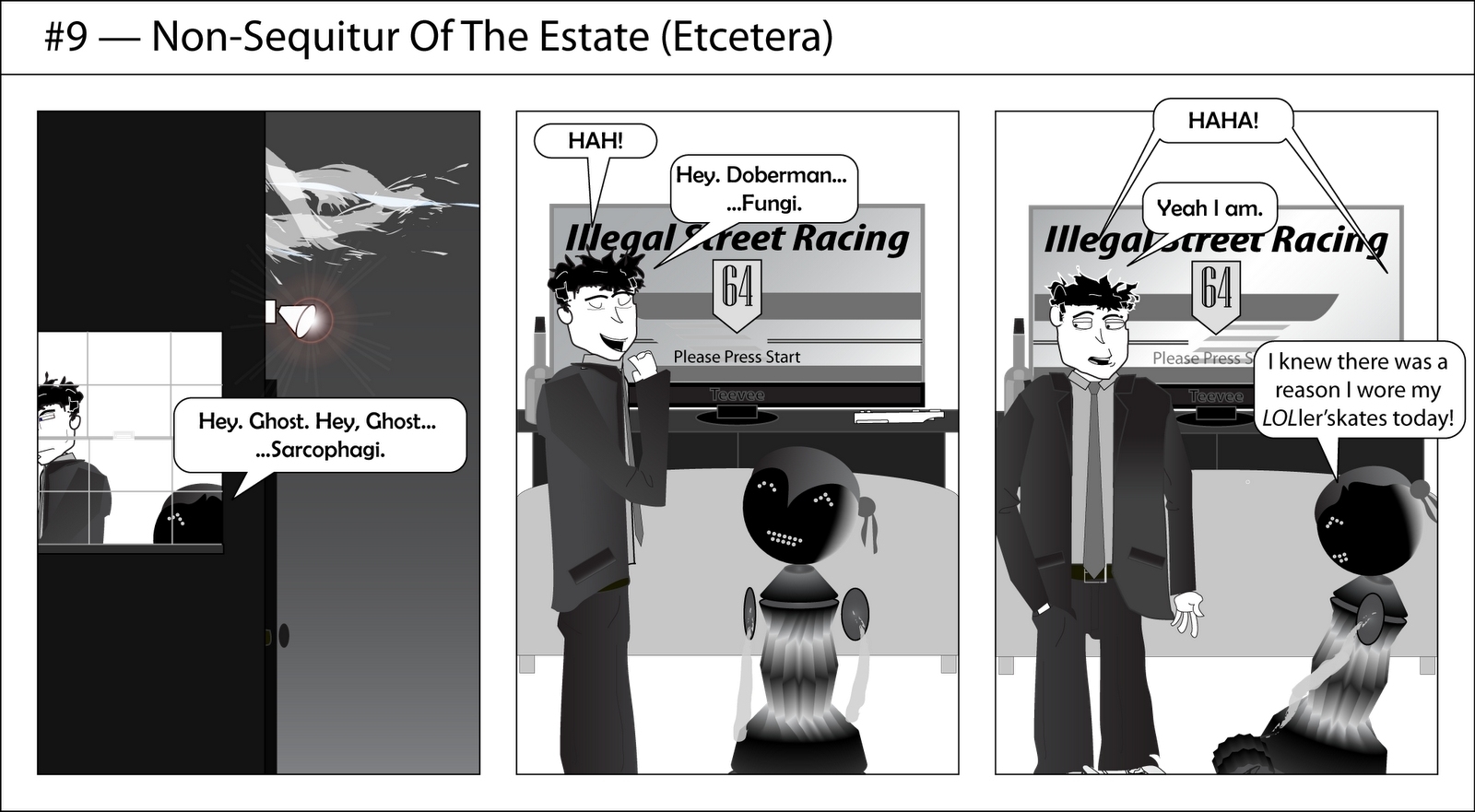
#9 -- Non-Sequitur Of The Estate (Etcetera)

"The audience just took their massive erections home and did stuff that would still be sung about in the halls of Valhalla come Ragnarok. Stuff that would make you and your partner experience the full repercussions of the Coriolis Effect."

We need to talk about stylistic consistency. As a framing device, we'll begin by describing why The Legend of Zelda: Twilight Princess is a piece of shit. 

In 1998, the Greatest Video Game of All Time was released, and it was better than good. This was, and is, The Legend of Zelda: Ocarina of Time (* * * * out of 4), the game that made all the other games ache with envy. It was a new flavor of ice cream, and while you ate it, somebody played a fun snare drum beat to keep you in rhythm. It stunned with its setting, its latitude, and its focused minimalism. Seeing it today is like watching a 1964 Aston Martin DB5 drive by, windows down, radio playing a familiar tune, and you suddenly get thirsty. From beginning to end, it knew what it was doing, quietly going about its business, tightening screws, adding spice, and cracking its knuckles at all the right moments. It even stopped for smoking breaks once in a while, because you suddenly realized you wanted to smoke cigarette, if only one time. The best smoke of your life -- why ruin it? It was restrained and had a keen edge, making its precise blade strokes when it needed to, and then returning without a drop of blood back into its sheath. The game was a 5-movement orchestra, and every piece of that orchestra complimented the man (or woman) in the chair next to them while the concert was in progress. And then they complimented each other again later, with words, at the after party. 

In short, it didn't dance like one person's choreography. Instead, it crushed the whole goddamn scene like dance troupe, team name: "The Democratic People's Republic Of Infinite Christmas Banana Pancakes." It did its thing and it stunned people so hard that they could barely applaud. The audience just took their massive erections home and did stuff that would still be sung about in the halls of Valhalla come Ragnarok. Stuff that would make you and your partner experience the full repercussions of the Coriolis Effect.

In Zelda: Ocarina, and to an even greater extent in its sexy-cousin/sequel, Majora's Mask, everything had a place and every character had a Dickensian purpose. The center of the world had a vast Persian rug that smelt good and well-traveled, and every corner contained an etched statue with a story, or a piece of family memorabilia, or music box that played a familiar snare drum beat. If you looked closely at these things, it dawns on you that this world was actually made of other worlds, and when viewed from afar, you realized it had been made by a thousand tiny gods. All thinking the same thing. All hoping for the same thing. And all for you. You'll never want to smoke another cigarette again. 

Like so much pink insulation, The Legend of Zelda: Twilight Princess was made by a million tiny bits of lint and wooden splinters coalescing behind your dryer. It sort of collected back there, got stuck to your sock, and then somehow ended up in your coffee cup on, like, what was up until that point, a pretty good day. Well, it dissolved pretty quickly in your coffee, and it looks the same, and (wait, what's that, does somebody have their headphones turned up way loud? We can hear a song that. . . never mind, probably nothing), how bad can it be? You sip it and it barely tastes different. Then you get home and you have woodchips stuck in your gums and your lips are all sliced-up. Fuck.

See, the issue with Twilight Princess was that it was created by a dozen-hundred people that exclusively read romance novels. They have, however, never themselves been in love before. They might have convinced themselves, and anybody else that will listen, that they have. The fatal flaw keeps coming back though. Crabby, frustrated, but focused, these people moved their pieces around the checkerboard in a perverse, wrong simulation of what they've come to understand is the emotion people most want to feel -- slamming pieces down after each turn, assuring themselves they'd done right. After a few rounds of checkers, and realizing they can't figure out any ways between the six of them how to improve the game, they decide that's enough, they've sufficiently simulated the feeling of being in love, and package the thing. Each package comes with 15 boards, 15 red pieces and 15 black pieces.

Thing is, they all had different opinions on what the game was actually about. Was it supposed to resemble something old? Was it meant to be familiar? What are all these empty squares about? What were they thinking exactly when they made the game? No instructions were included, so the dearth of components resembling a familiar game just became puzzling to people that bought it. This begat harsh feelings. Twinges of dishonesty and betrayal. It made your gums bleed again just thinking about it.

Knowing what it should feel like -- that buzz of affection, effects not to be mistaken or faked -- it was all the more apparent that Twilight Princess was a cardboard cut-out in the background of a 3D movie. 

Its style wanted to be everything, which is not a style (just like how jamming on the START button to make your Mario Kart opponent lose rhythm is not a style and not a move). It was dreamed up as a flat world for all of your (and all of your friends) favorite old memories and fantasies to live in, but like Narnia, it had to die. Memories aren't flat, they can't exist like that. They're made of thicker stuff. They can't be dipped in fudge and thrown in a corner. You can try to do that, and point to what you've done, but that still doesn't help the fact that you dunked your friend's old classic rock mix-tape in Hershey's Genuine Chocolate-Flavored Syrup and flung it in their fucking face!

That's not what they want, and it's not like you to do that. Baby, you took something that might not have ever really existed in the first place and gilded it. Then you sold it, after slapping a badly-drawn plastic dust jacket and called it something unmistakably retromingent like Twilight Princess. In an effort to make something that can appeal to everybody, so was an inferior product created. One that nobody can relate to.

(click to embiggen)

-- Ghost Little
on Twitter  |  @GhostLittle_WTF

Wednesday, December 8, 2010

#8 -- Non-Sequitur Of The Estate

"Post-modernism is mouse on stilts offering you the chance to buy a used World War I tank. When you buy it and climb inside it for the first time, you realize it's made of bread."

We wonder sometimes if it would make sense to write this blog on anything but an actual computer keyboard. It's the lexical equivalent of using something other than a hammer and chisel to kill a vampire. Altering your state alters your perspective. What if we typed just on a BlackBerry (which we don't have)? What if we just wrote and drew everything on an iPad touchscreen (which, again, we don't have). Modern humans fight the self-canceling advantage of rapid typing on a daily basis. We create, inhabit, and interpret what we're hammering out in tandem, and that's going to eventually be an issue. The QWERTY keyboard was invented on typewriters to slow down typing speed so the hammers wouldn't jam. What are we missing when our fingers start moving faster than our brains and our words move faster than human logic?

Paradise Lost by John Milton is the greatest fucking thing ever written down on paper. The guy was blind and he had to dictate it to somebody (his daughter? I don't recall right at this second, but that sounds right). The words -- lyrics, really -- were hypnotically recited by a man without vision, spoken, seen in the mind's eye of the scribe, and put to the page. Imagine the trust and the confidence required on both sides for this to work. Every line inhabited the mind, the spoken voice, and page at the same time while it was being written. And it came out slowly. It came out slowly because it had to be imagined up first. The very process of writing this epic poem was art. How could it not be?

There will never be anything like it ever again. A blind man reciting his interpretation of the Fall of Eden in verse to another person of the course of many years. Count the variables in that sentence. Most importantly of all, is the question of "For whom?" Milton answers this plainly: to justify the ways of God to men. This is a thing that could never exist in our current modern age. It would be clouded, laughed off, ignored, degraded, and escaped. The identity of its writer would be questioned. Its purpose would be questioned. Art can't stand on one leg.

Correct art has to exist in obscurity. It's not a required to be a mystery. It's best when it possesses ambiguity. It needn't be deliberately complex, but it wins points if it makes somebody over-think. Conscious deliberation is difficult to capture at 125 words per minute.

What if a writer existed as a living myth? What if the lines between what was written and created became blurred with what was lived in reality? What if the stories of non-fiction were as deliberately planned as those on the page? What if the method wasn't really madness? It's no longer a story that you inhabit, it then begins to inhabit you. Always a step ahead. Would anybody even bother to examine the truth? Would the writer, the artist care? Is that part of the plan?

Post-modernism is retarded. Post-modernism is mouse on stilts offering you the chance to buy a used World War I tank. When you buy it and climb inside it for the first time, you realize it's made of bread. There's no reason. It exists so the artist can collect enough money so he or she can buy a telescope. The telescope can be pointed in any direction and the artist gets the lulz every time they look through it. That's not art. That's sticking your dick in tube of your roommates toothpaste.

The purpose of art is to incite spirited conversation that eventually matriculates into luminous thoughts. Count the variables in that sentence. Imagine you stare at a Monet for days or years. You never tell anybody that you stared at that painting for as long as you did, that's something you keep inside. Decades later, you still don't get it, but you take a nap in the sun, call your grandson, and drink a bottle of local beer. Monet doesn't win, but he's very glad that you have.

We'll never tell you where we're going.

(click to embiggen)

-- Ghost Little
on Twitter  |  @GhostLittle_WTF
#7 -- Do They, You Know... Of Electric Sheep?

"People talk about the distribution of wealth in modern times. Imagine that, except a double-kujillion times worse, plus religious control, times XFINITY! The bosses of religion were the equivalent of Isaac Hayes in Escape From New York."

I recently read a report that a nail -- roughly 3.5 inches long and pretty intimidating as far as nails go (overcompensating, Trent Reznor? (I kid, you fucking rock (I fucking hate Kid Rock))) -- was discovered during a dig on a tiny island off the coast of Madeira. Madeira is a decent-sized island that's technically part of Portugal, and is actually located in the Atlantic off the coast of Morocco. Now, the tiny island had a fort on it, and inside that fort was a box, and in that box was where they found the 3.5 inch nail. What's interesting about the nail is that it's not all that rust, and is in fact quite smooth and well-preserved. And do you know who once held that fort? The Knights Templar! Really? The same Knights that occupied Jerusalem during the first Crusade in the 12th century? Of course. Does that mean... oh, holy (!) shit!! This nail is significant! It may, or may not, but it just might, have been used to crucify somebody. Know anybody important in history not named Brian that was crucified

The immediate conclusion to jump to is that this ancient nail is in such fine condition centuries later is because Christ bled on it, and his blood has the qualities of silver polish, natch. Now, that's a pretty keen superpower, but it's also really highly fucking unlikely! And anybody that that theory can stand on that evidence is asking a whole lot. 

Chances are, this nail was used to attach Jesus to The Cross. A Cross? A cross. I mean, that cross wasn't significant. It was? Oh, well, I'm not capitalizing it, just like I don't have to clarify who Jesus was. 

During their occupation of Jerusalem from 1099 to 1147, the Knights Templar, who we all know as the iron right hand of the might Pope Urban II (the ghetto Pope), seized many divine artifacts from the Holy Land. One of which was most definitely a certain nail. And they hid it, because shit that Jesus touched couldn't just be on display for people to see. It had to be hidden. In a box in a fort on an island off the coast of Morocco under Portuguese control. Nobody expects The Man From Lisbon! Bwahahahaaa! 

It's pretty plain to see that Pop Urban II had a great deal of foresight. He knew, using his God-future-vision-infallibility, that Jesus would be pissed if he didn't hide the very nail that the Romans had used to hang him on the cross (a cross? (across from what? (hah! Thanks, Mitch Hurwitz!))), an act through which he absolved all the sins of humanity up until that point. And seriously, it's a special 'effing nail. It's super-smooth and mad-tasty, like drinking a blended cashmere sweater. Hello, son-of-God blood! That's why all these artifacts keep popping up in great condition. Because it's stuff Jesus bled on. 

If it's so well-preserved, how come they even bother digging it up? They're just going to throw it in a closet somewhere. Tangentially, you cannot be fucking serious! Do you know how stupid people were during the Crusades / Middle Ages / Medieval / Dark Ages. There is not a single person on earth that looks back on an era of fiefdoms and feudal lords, and says, "gosh, things were at their best back then. What progressive, humane, honest, caring people that lived in those centuries that have literally be labeled the Dark Ages. I mean, they must've been both wise and smart." Pope Urban II probably had leprosy and slapped  a beard of leeches on his face if he caught a cold. He was some old Italian motherfucker that most likely ordered thousands of knights to go die for God and... well, God, again, countries hadn't really been invented yet, and that all their sins would be re-missed. Like he's some kind of claims collector. In his wisdom and divine, loving soul, he told people to go and die for his lecherous ass. 

Is it at all possible that he planned this? That he could engineer a conspiracy of this level? Think of people like Copernicus or Newton, some of the smartest men in history, and they were still probably dumber than the dumbest stoner at Brown University. 

But, BUT! That was all a FRONT set up by the Pope! No, honestly, look at all the evidence! The Pope had to do that because he was informed by the doctrine of Un'skenth Grah (made up just now to prove a point, not real), which was what Jesus secretly passed on to the 13th Unknown Apostle, that all physical evidence of Jesus has to be hidden from humanity's sight. It was all a power-grab! That's where the Knights Templare came in. They were Urban II's personal guard, his SS, if you will, and they followed his orders blindly. They were like the terminators from Terminator Salvation, and they were sworn to protect all Jesus merch for a thousand years to conceal the fact that they were really... well, clueless, mostly. 

I know, right? Intense. It was basically to conceal the fact that the Knights Templar, the Pope, the Catholic Church, fuck, anybody in power at that time, were a clueless band of lazy, incestuous, boy-rapist, shit-wreathed lords that liked getting blumpkins from anybody (anybody!). People talk about the distribution of wealth in modern times. Imagine that, except a double-kujillion times worse, plus religious control, times XFINITY! The bosses of religion were the equivalent of Isaac Hayes in Escape From New York. They were leaders of the world's biggest street gang. Think of all the awful stories you've heard about the shit that nasty gangs, whether in movies, or in real life, or in Baltimore, have done over the years. Now think of all the worst stories you've read about in your fucking history books about genocide and holy wars and burning cities to the ground rather than letting your enemy hold it for a moment. 

(click to embiggen)

-- Ghost Little
on Twitter  |  @GhostLittle_WTF

Thursday, December 2, 2010

#6 -- Up For Debate

"I'm a fucking transcendental spirit of an intangible nirvana. My soul is carved out of Italian marble. I don't have issues, I eat lions! Why don't you realize that? You don't realize that because I'm a fucking trans-dimensional whale-god among plankton! Paul Atriedes ain't got shit on me!"

Know what's weird? We feed on the misery of others. Idolatry is no more. We are too aware. Knowledge of everybody can be found anywhere (Hi, pop culture! Hi, Wikileaks!).

A space occupied half a century ago in America by baseball heroes, war heroes, and The Splendid Splinter -- who was both! -- our admiration of the famous, skillful, and merit-worthy has become an obsessed dependence. Heroes are too much like us, flaws enhanced because we asked them to be magnified mortals, we have unwittingly bestowed the kiss of death on our former aspirations -- because our own dreams were killed years ago. Our heroes disgust us now. We share their pain and co-opt their drama, nodding assuredly at one another at their unenviable lives. We quite literally pay them to dance and then mock them for being self-indulgent twats.

The pedestal remains vacant. Anybody that attempts to ascend to it, to embrace heroics, to crown themselves, willfully or not, is dragged over a comically over-sized cheese grater. Their positive traits are warped. Their triumph is temporary. They age and wilt. They are skinned and spun. They are entirely visible, becoming more icons to be loathed for their over-exposure rather than for why they are there. There are questions we ask them:
  • "Why don't you talk to the press more?"
  • "Why aren't you more humble?"
  • "Why do you adopt brash cliches from eras past? We're in modern times now, you know."
  • "Why aren't you human?"
  • "What is the statement you're trying to make?"
  • "Why don't you want to be a hero -- or do you actually want that title?"
  • "What is your background, and who do you think you are?"
  • "Why don't you need us?"
Let's pretend for a second that we're heroes of our modern epoch being asked these questions. Here's a sample Q&A session (this is how it's done, Derek Anderson, you bearded crybaby):

Q: "It seems like you're abrasive when your facial cues are put under a microscope -- why don't you talk to us more often about them?"
A: "Well, I don't talk about them because I'm dealing with some shit that you bog-dwellers can't comprehend. Do you know how complex my fucking life is? My skills are needed in five different places today and my look-alike has to make fifteen different appearances to keep up the charade that I care what you think. You want to know what's been irking me? I'm low on caffeine right now and I'm tired. Psyche! I'm a fucking transcendental spirit of an intangible nirvana. My soul is carved out of Italian marble. I don't have issues, I eat lions! Why don't you realize that? You don't realize that because I'm a fucking trans-dimensional whale-god among plankton! Paul Atriedes ain't got shit on me! Your 'experts' have got their analysis wrong. I'm a doctor of psychology-wielding devourer of bullshit. Stop wasting my time inundating me with whatever falls out of that sphincter god sewed onto your face. Next question."

Q: "We live in an era of transparency and connectivity -- why do you stand for the golden archetypes of ages past that our fathers and grandfathers once admired, obviously trite cliches that they are? I guess what I'm asking is; what are you hiding? What about you have we not found out?"
A: "There's nothing to find, and you should swallow an ice-pick for thinking your life would personally be better without my greatness in it. You think you're at the top of the ego food chain because you pick apart the revered -- the heroes. I'm above you, and most people are. If I were a quivering mass of Facebook like the rest of you, nobody would be making any decisions around here. Heroics are more human than you've ever given them credit for. They're as universal as they are legendary. I keep my thoughts guarded. I keep my intentions distant. Understand this, when you need to find north on a compass, you can stare uphill at me. I am the right thing. I am boundless. Heroes operate outside of the rules that my enemies wish were set in stone. Smashing written laws was good enough for Moses, so it's good enough for me. Twenty-first century heroes are impotent, sexless demi-gods brewed to the lowest-common denominator. Fuck Taylor Swift. I'm not complex? I'm a trite cliche? I've forgotten better than your best. If I puked in a fountain pen and mailed it to the monkey house, I'd get better work than what you're scribbling down right now. The life I lead is so great that centuries in the future, kids will still want to be me when they grow up."

Q: "You're a little rough on the exterior -- why aren't you more humble?"
A: "Listen, I was raised on the back of a giant turtle in the middle of an ocean on a planet you've never heard of. My heroics will be lauded in hallowed halls over raised glasses of ambrosia come Ragnarok. I was genetically engineered from birth to be perfect in every way. I got dunked head first into the River Styx. It's not my fault that I look this good but it's definitely your fault that you aren't more humbled to be in my presence. I'm a role-model for all good things in the world, and I'm about to teach a lesson here: Don't tolerate whiny sacks of shit that exist only to leach and smear. You can't touch me, don't even try, you dickless human stain. Why am I not more humble? Because then I'd be you. Nobody would benefit. Because my existence would redundant without the golden wall made of guitar-shredding T-Rexes between us. Do as I say, not as I do. Muppet. Now get the fuck out of my sight before I order your sister off of Craigslist."

Q: "What is your background, who do you think you are, and what gives you the right to be a credible voice on the subjects of goodness and badness."
A: "What's my credibility? Here's my credibility: a person, me, without credibility has visibly rattled somebody, you, that thinks very highly of themselves. Get fucked, old man. Listen, if I wanted information about how shitty McCarthyism was or what public racism really looked like, I'd go to you. The issue here is that young people of this modern generation are either spineless or chained by tradition. They are told they have no credibility because their elders still live. Heroes don't wait their turn. Heroes don't wait for their certificate of credibility to arrive in the fucking mail! Heroes are dissatisfied with the inefficiency of 'that's the way it is.' What, clout is a limited commodity and I can't have any until you're done with it? No! Not in a million shitting years! The cagiest parts of our status quo must be rejected if it's to the benefit of the greater good. Do you agree? The best prove their credibility inadvertently."

Or, on the flipside, you can stop being an arrogant prick and just enjoy Pixar movies.

(click to embiggen)

-- Ghost Little
on Twitter  |  @GhostLittle_WTF