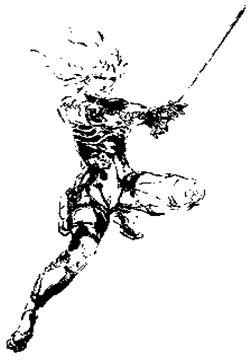
". . .an adventure set within the architecture of a sub-human mind."
"It's bad parenting."
". . .(it does not turn) escapism into algebra."
". . .the sequel to youth."
In a mixture of moods, The Legend of Zelda: Skyward Sword's first hour contained abundant, bizarre sexual innuendo, and a fully-orchestral soundtrack that sounded like an actual French horn trying its hardest to mimic a bumbling 8-bit Famicom chip-tune. We had arrived at an unanticipated challenge. Well, we thought we had, but then we were rescuing agreeable seed-creatures from piggish malcontents in the forest fifteen minutes later, cementing Skyward Sword's status as a veiled insult from an old friend, a notion that probably has its own word in German or an older Russian dialect with no direct translation into English.
It'd be something sexy, but hurtful-sounding like 'schlippenshenken' or 'klebbreznyev.' That's what the game is -- an estranged acquaintance slighting you in a dead language with a word that still makes you feel good-dirty somehow.
It was clear from the word "go" that things were dire. We were already counting the obstructions between us and the game that we had wanted to play since 2006, expending energy to convince ourselves that we really ought to sprout some compassion and some patience and not to worry about the prickling feeling that we had walked into the wrong party. We drank a pint and a half of what might've been paint-thinner out of a tin can we found in the garage, consciousness regressing to age thirteen in a matter of moments after consumption. This was a nasty trap Nintendo pulled, creating a game that's quite beyond criticism without cosplaying as The Man With No Brains, who is a person that we just made up.
This may be the last decent Wii game, a console that we dissected in episodes past. We wish this wasn't a Zelda game, creamy-rich watercolor art and un-ironic earnestness right where we left it five years ago when we put The Wind Waker back in its case after double-checking that the series was actually super-good. We wish Twilight Princess hadn't ruined things for everybody and that Skyward Sword wasn't a self-conscious Junior Messiah trying to set things right again after his older brother turned his family into a bunch of social pariahs living in a glossy-white McMansion on the north side of town. We wish it wasn't a Nintendo game, and we could write it off as a shitty iPhone port tattooed onto the bloated cadaver that is the Wii. It isn't though.
It is a Nintendo game, the keenest since Metroid Prime, and it is a Zelda game, the heaviest since Majora's Mask. It's also a walking contradiction that is somehow both busy and boring, quaint and draconian, lovable and impossible. Ain't no way around it now. Shit's gon get reals. Konichiwa, bitches.
And hey, like we mentioned before a second ago, that last console Zelda game, Twilight Princess, was a teeth-grindingly overcooked ulcer-parfait that felt like a fan-mod created by a dude that would use the phrase, "badASS" every chance he could, but had never actually won a fistfight in his entire life. So Skyward Sword had a ton riding on it! So what? If humans hadn't invented anticipation, then the most popular word on Twitter would be "maybe," which it so isn't! The Egyptian Pharaohs, specifically, invented anticipation, by the way, looking forward to their deaths from the moment they were born.
Let's not talk about Egypt though, maybe later. Back in 1986, The Legend of Zelda was a game that could turn 8-bit technology into a journey that anybody with an adventurous spirit and a mug of hot chocolate could engage with on a rainy day. As time went by though, Nintendo began to realize that only people in the glassy-eyed adventurer market were buying these Zelda games, impenetrable wandering-simulations that they were -- so they turned up their noses at that demographic and began to direct their technical prowess at making these adventures into liquid assets that a helicopter-parent wouldn't be afraid to buy. The idea was that Nintendo always wanted to make games that appealed to everybody, but didn't have the technology to make them blatant and infantile enough to sell them to the deranged and brainless, so with the advent of the Wii, they finally had the means to deliver a Zelda game banal enough for everybody, even though the franchise had raised a generation of 16-bit zealous, sword-grinding mountain-climbers that had no desire for kind voices in their ears. Nintendo has no desire to be hip, only to sell games that any 'ole person might buy. They don't love you -- they love everybody (just like God!), specifically (okay, maybe not like God), the idea of everybody, and filling sacks upon sacks with fist-fulls of their money.
The outcome is a game that barely lets you think, let alone feel. Games give you moods, and in 2012, few of them give you despair, desperation, a longing to quit, and a spark of hope when you don't. There should be the chance that you won't be able to finish a game, otherwise, the game has not engaged something tangible within you. If you cannot lose, then you have, in a sense, already won -- so what's the point?
The response is: The Journey. It must be a hell of a Journey through thick and thin. We're so going to go on an adventure right now! That is how the game will need to become entangled with you. The adventure of a lifetime! Again! The Zelda 8: The Re-Adventurening!
Honestly, you're going to feel something tangible within you even when you're playing Candyland, or Chutes and Ladders, or LIFE, or Sorry! (we fucking love Sorry! Exclamation point: confirmed), so if a videogame can't elicit that kind of emotion, then we should just go live with the Amish. They have such fine chin-beards.
Skyward Sword provides no such emotional entanglement though -- no challenge, no compensation. This really is the Final Fantasy XIII of Zelda games (or Nintendo games in general, kinda), where we walked out of the last level at full-health, looked around and muttered, sober, "Guys, we can't keep coming to this party. Seriously, we have to get jobs." As an aside, we most certainly are employed at an American company right now. How do you think we can afford to buy enough food to nourish our bodies so our brains can function and we can develop critiques about things? We aren't living on a fourteenth century French feudal fief for fuck's sake! We can think for ourselves. The sun does not revolve around the earth, and not all Zelda games are good.
What is Nintendo expecting of us? Do they wager us imbeciles with a wall adorned with "Participation" trophies? Do they assume our hands have been blown off in a hilarious fire-cracker incident, or that we've failed at suicide in a ton of different ways? The trouble is that when the game is at its goddamn pandering-worst, it doesn't make you feel like a kid on a grand, all-new adventure, it makes you feel like a teenager that's too old to be baby-sat. When Skyward Sword stops you in your tracks and taps you on the shoulder, asking "Hey, did you hear that?" when, yeah, that noise that's been growing louder as we climb this tree is pretty damn audible, man, it's a videogame, not a silent movie, it's like going to the drive-in with somebody that you actively want to break up with. It's so damn obvious that these intrusions aren't there because the game wants to be legitimately helpful, but instead because there were kids that actually stopped playing A Link to the Past on the SNES back in 1991 when they couldn't figure out how to use the magic mirror on Death Mountain. Nintendo assumed, and probably rightfully-so, that those people would never buy a Zelda game again, so they overcompensated like truck-nutz and cooked up the most dry, insensitive hint-giver to live in your fucking sword, of all things, to hold your hair and rub your back so you don't uncontrollably shit your pants in knee-hugging desperation.
Fi, your hint-giving companion, turns an adventure that should be as thrilling as the first real outdoor kiss of your life into your darkest humiliation ever. She's probably The Mother that Roger Waters was singing about in that one track off of the first side of Pink Floyd's The Wall.
We have dreams about never-ending levels that roll without interruption and we have come close at times, like the top-to-bottom run in SSX3 or Zone Mode in WipEout HD. When they're going to work, they're waking dreams. Fi makes damn sure that Skyward Sword will never come near that kind of rolling plushness games should aspire to. Her psychotic mothering resembles a version of Monopoly set within an occupied police-state. There's a sequence near the end where you have to climb a volcano and collect your stolen equipment as you go. Your sword contains Fi, which has been taken from you, so for the first time, you are without her, stalking through guard-ambushes like Garrett the Thief, robbing chests and clicking your tongue in self-satisfaction. It's great. It's the best part of the game. Then you get your sword back, and it's back to "There's a 60% chance you're near your destination." What a fun holiday that was without you, Mother. Later on, prior to the final boss fight, there's a terribly-shot cinematic (the "camera" work in the game's cut-scenes is as gruesome as being the only sober one at a Halloween party, demonstrating just how lazy Nintendo gets with certain parts of the presentation) that takes roughly two minutes of slow panning-shots of the sky, some low-resolution grass, and the villain breathing happily, a dead-ringer for Street Fighter's Akuma. This mini-movie's end-product is both the villain and your sidekick explaining that you'll be given the chance to save prior to this last fight. The villain mutters some-such dialog about, "Come find me when you're ready, I'll be on top of this teleporting darkness-shaft."
You could lose half of the painfully-translated written dialog and tell a sharper story, and what is there is all so impotent and meaningless. Please, Nintendo, get angry, throw a chair, be self-aware or bombastic, just please develop some kind of style. A great deal of the text is spent on exposition, guys saying stuff like, "Link, this might be dangerous!" or "That lava looks hot." or "Be careful you don't fall off the platform." In that case, falling off the platform doesn't cause any actual bodily harm -- why don't we want to fall off the platform again? This carves crevasses between you, the story, Link, the world, and naturally-occurring endorphins of any type.
Videogames should be presented as problems where your sharp mind is the solution, not as guided tours that treat you like chimp on the first day in an FDA testing-lab. It's terrible because we are suffering for the sins of the stupid. At times, Skyward Sword is an adventure set within the architecture of a sub-human mind. In fact, the game will be stupid at you because some time after Ocarina of Time came out, focus groups in Japan were concerned about getting lost in the woods in the most critically-acclaimed game of all time. It's not real, dude! You aren't actually lost in the woods! This is what you're doing to forget you ride the train to work and live in a cubicle, where you'll die, and your dad will never, ever love you. What's so important that spacing out in a hyper-green impressionistc Cezanne painting is not a good use of your time? Skyward Sword was not made for you. It was actually made for skeptics and for people that don't know better.
We can't tell if this game is Scotch through a sippy-cup or a martini made with blue Kool-Aid. Mixed signals abound!
Surely they wouldn't let the creative vision suffer for this? It unfortunately does, and we're so generous that we'll even explain why.
Are Nintendo games being played by idiots, by children, or by the mentally-castrated? It's obvious they've thought far too long and hard about that question. No argument, Nintendo's modern games are designed so that children can engage with them, and probably even beat them, demonstrated by the fact that almost every NPC in the game speaks to Link as if he is a six year-old with a pussing head-wound and a sexual attraction to the blanket he was brought home from the hospital in. And an adult human playing a Zelda game in 2012 will feel betrayed that advancements in technology have been used to wrench away their rightful Zelda and replaced with this type of timeless pandering that your aunt usually goes into at your family weddings about how "You're next!" (We tell them the same thing at family funerals.)
There used to be so little data space in games that they had to actually put hints and directions on how to play them in physical booklets packaged with the games! GTFO, right? It's a goddamn weird thing that the game is so arcane with its restrictions at times, and in other moments, it pesters you like an iTunes update. Ah, and Zelda, glorious, Zelda. Those were adventures that were once emotionally-touching because they required us to grow the fuck up, hammering home the cast-iron life lesson that nobody will help you out here in the wild, you baby -- run away if you're too scared! In time though, such games, and such threats, they wilted before our courage, and we were victorious. Even the toughest challenges became nightmares that you could beat up if you were wise and sly enough.

No, today, Nintendo games are all about everybody seeing everything, and that's part of how the games are designed now -- they have reams and reams of data stored on the disc to punch and prod the player forward to make sure they never get lost or forget anything. If you asked the game's director what the most important thing was when they were developing this game, he wouldn't say the story or the combat, he'd say: "Enjoying the world, and all the things we've put in it, of course." These helpful hints and informational overload are entirely considered to be "part of the design" for Nintendo. But they're just hints, right? Can we make them an option? Can we turn off Baby Mode? Emphatically "NO." Arguing for making something that's "part of the design" an option that can be turned on or off is like asking a Christian if, "Hey, what if Jesus wasn't a human? What if he was a squid? And did you ever consider that he might hate you?" It does not compute. That's what Skyward Sword is: somebody that had no need to find Jesus, but did, and with that, you have to take that person and all their baggage as one. The arcane design is part of the game's entirety, it's the game's luggage, and as a rule, it becomes a part of "The Zelda" we have today. The game believes that there's no need to change or question anything -- the Design is Intelligent. That's why no Mario game has ever had customizable controls. Everything is as it should be and is better than you could ever know, Luddite, shut up and drink your prune juice. Nintendo presents holistic games, and they're usually right, sort of because they're geniuses, and sort of because they're miraculous, and sort of because they're lucky with their mass-appeal to 80's Nostalgianauts with disposable income (As an aside, Nintendo translates to "Leave luck to Heaven." Appropriate.). Everything in Nintendo games is placed therein with meticulous purpose, and if you want to remove one piece, the moronic reminders and hints, in this case, then you might as well throw out the entire game as far as Shigeru Miyamoto is concerned (psst! He invented Mario, Donkey Kong, and Zelda!).
Winning in Zelda once required the power of human perseverance. At the end of games like Super Mario World and A Link to the Past, they'd have these lengthy montages recapping all the worlds you've conquered and the people you've saved, and you remember how far you've come. The satisfaction is inimitable, reminding you that "These are the places you've been. Can you even remember that far back?" It was all you! That was a long time ago, though. Now, we're edging up against The Legend of Zelda: The Digital, Interactive PRIMA Strategy Guide 2011. The misguided compulsion to stray, to wander, and to keep trying, even if we think we've exhausted every option and even if we were almost certain we might fail -- that was what made Zelda games great.
Want to know what we never said while playing Skyward Sword? "Gonna try something. It's gonna be stupid, but it just might save us if it does!" And then after weeks of trying everything, you swing your sword and whack Phantom Ganon's fireballs back at him and it works! Those compulsions are all but excised.
Removing those things do not remove Skyward Sword from greatness though. Skyward is great, and for the first time in 13 years, it is not great simply because it is a Zelda game. It is great because it is actively indifferent to all other games released in 2011. As a Zelda fan for all the years that the series has existed though, we are trying desperately to find that greatness with a gigantic, expensive microscope, waving colleagues over to our shoulders every time we discover some new element that might yet prove that, yes, Skyward Sword is indeed the cure for cancer and bullshit, as we hoped it would be.
This sleepless, desperate research on the part of What's That From's R&D Department to find the good in Zelda again stems from a game that came out in 2006. That game would be Twilight Princess, the most callous grocery list ever written that fully confirmed that Nintendo didn't know what made their games great. It felt like a cover-band trying to play their own riff of Dark Side of the Moon, stopping in between every song to point out that they have CDs and t-shirts at a table at the back of the room, won't you support the arts and buy them? Then the frontman sang "Great Gig In The Sky" and you felt bullet-wounds in your thigh that you'd never received. It was used coffee-grounds. It was junior varsity. It was Edith Crawley. It was so cringe-worthy, stopping you every time you pick up a blue rupee to remind you that: "This is a blue rupee, it's worth 5 rupees, that's pretty nice," that you'll never unclench your sphincter while playing Twilight Princess.
To understand how badly this game suffered because of the small things piling up, consider the following statement about the strongest memory we have in Twilight Princess, a game we played for 50 some-odd hours. Eventually, in Twilight Princess, you get the ability to morph into a wolf-form whenever you want -- except you can't. You can't do it if somebody is watching and whether or not somebody "is watching" is entirely impossible to determine, and you can only teleport if you're a wolf, so to teleport, you have to be twenty to one hundred feet away (it varies) from all NPCs, to turn into a wolf, to teleport. However, you can change from a wolf back into a person wherever you damn well please.
Are you fucking kidding? There was no joy in that game. It was sitting in line at a tollbooth. It was a stretched-out JPEG of an ex-girlfriend. It was revenge-sex that you somehow felt worse after.
Nintendo set out with Twilight Princess to make something better than Ocarina of Time (++ CERTIFIED: Best Game Ever ++). Tonally inconsistent and trembling like Bambi on ice, they tried to make something better by creating a half-remake, half-reboot, half-Wikipedia article that ended up being an misshapen abomination against God with 50% more limbs than it should. You cannot beat a classic with a remake. In fact, the most refreshing thing about Skyward Sword is how much they seem to be dodging potential comparisons to Ocarina, maybe not deliberately, it doesn't matter. Skyward Sword does not technically take place in the normal kingdom of Hyrule, it has drastically altered Link's locomotion (a sprint button!) and combat (accurate'ish waggle), and it does not involve a horse named Epona, substituting instead with a giant red bird, who has no name.
We said in our ExciteTruck review that the floaty non-control that the Wii remote provided was the driving force that made the game unique. The bird-flying is the first motion-control side-show that's worth mentioning and it gives off the exact same feeling of sorta-there control, making you feel that, okay, you are wrangling an animal, and it's not the most obedient thing, and that airiness is adding to the flightiness. Agro, the horse in Shadow of the Colossus had a similarly disobedient feel to its mount and it turned the "X" button on the PS2 controller into the "desperation" button, sending Wander, your character, into a begging scream for his horse to come save him as the twenty-story lightning turtle readied up its Thundergeddon Cannon. The bird isn't quite Agro The Horse though. You just don't spend as much time with him. By the end of the game, we realized that 15% of our time was spent on the bird. It takes five minutes to cross The Sky on the bird. It's really more of a screen saver that you can play. Flower (* * * * out of 4), a $10 downloadable game on PSN is a better flight simulation than the bird-flying in Skyward Sword. On the combat side, Link's motion-controlled sword-swinging is also floaty and lacks confidence, but Link is kind of a floaty dude that lacks confidence, at least at first. There's an argument that could be made that if you, human, are role-playing as an amateur adventurer, like Link, you won't be an expert swordsman the moment you pick up a blade, and that's what it's like, difficult and inconsistent. This is a man that runs around with his sword held out in front of him, letting the blade lead him instead of letting the blade become an extension of his body, advice that we probably picked up from Li Mu Bai -- in time, you'll master the controls and they don't get in the way any more than they do in any other game. The controls are of biggest consideration in the combat where sword-swinging becomes bound to the Wii Motion-plus Special Powers, but the motion control isn't why the combat is a stale loaf of sourdough. The combat is old bread because it lacks focus on technique. You can hammer on nearly all enemies with no battle-plan and win just fine with brute force, the last boss included. Do that in Ninja Gaiden or Bayonetta, games that demand technique and finesse in their combat, and you will never beat the game.
We'll just leave it at that.
Nevertheless, there are notable instants of revelation in the game. Fighting the first boss was the moment where we realized that this is the first real Zelda game that's different from Ocarina of Time / Majora's Mask, with no intended slight against The Wind Waker, which is utterly ageless and will still be beautiful when we're dead and in the ground. This boss, who's name is Ghirahim, for some reason, is the most anime-character in a Zelda game to date, dressing like a mixture of the Joker, Kuja, and any character that's ever worn a silver mask in a Gundam series (there are about a dozen of them, and they're so baddddd). He gives off sexually-aggressive vibrations that are demonic and disturbing, so much so that his boss-fight separated us from the Zelda series for the first time since 1998, leaving us lingering like an THC-induced out of body experience, hovering, self-conscious, and feeling weird. We had to re-learn, just for a second. Inhabiting Link was unfamiliar again. You try to wiggle your toes in a new pair of shoes and it feels odd as shit. Fuzzy, nice-smelling felt rubs on your socks, the laces aren't dirt-encrusted, and walking is indeed walking, and yet. . . it is not the walking you grew up with. This is not your father's walkin'. It's fancy-walkin' now.
The first boss took a bloody victory on the first attempt. We came back stronger and wiser on the second attempt. Thanks, Dark Souls.
And yet there are more humbling moments. Skyward Sword is a regression to significance and intimacy.
For example, in Grand Theft Auto IV, you can buy clothes. They are entirely cosmetic, outside of making Niko Bellic look swankier when he drives a not-Lamborghini off of the not-Brooklyn Bridge. Assassin's Creed II allows you to buy up property in cities like Florence and Venice to help you bankroll your swarthy Italian Ponzi Scheme. You can find so many things -- weapons, armor, more-improved armor, faster horses, hotter fire, meaner poison, and yet it flies across the screen like so much Excel spreasheeting.
We've rained shit down on Zelda, Twilight Princess, in particular, for Nintendo's insistence that we're lobotomized ponces, bludgeoning us with its insufferable hand-holding, explaining that, "Master Link, you've arrived in the Lanayru Mines," because it would have been impossible for us to see the fucking deserted mine in front of us, or read the floating text that says "Lanayru Mines" right after you said we'd arrived here. Fi, your no-armed Tron-sprite that speaks like a TI-83 calculator who learned English listening to Beatles LP's playing backwards, will tell you if you've taken significant damage and are running low on hearts. You can also look up into the upper left-hand corner to see, yes, hearts be running low, Not-Navi, also, Link's body is quite literally flashing fire-drill red and the TV is beeping just as obnoxiously as it did in Zelda II, twenty-something years ago when you were near-death. In a way, this is coddling the player and belittling them with redundant-redundant information and a mutated UI that still assumes we're blind and deaf, but somehow can still read a warning if put in front of us.
Children will never develop survival skills if they have 4 separate reminders that their health is running low. This isn't game design anymore, it's an interactive insult. It's bad parenting.
On the other hand though, there are times when this isn't pandering and it isn't an insult. It's well-intentioned. Animosity melts away, we suddenly felt guilty, facing what was actually just traditionalist kindness and manners, maybe older customs that we've misinterpreted from people visiting from a foreign land. We're misinterpreting this kindness. Zelda isn't capable of deliberate cruelty. It's just socially-awkward.
Telling you that you've arrived in a new location is a goddamn big deal. It's assurance, a vow, that this isn't just Some Desert. This isn't another city block in Saints' Row full of respawning NPC and it's not just another medieval stone city in Skyrim full of houses, each of which you can enter with a minor load-time, and then steal all the spoons out of.
In Skyward Sword, you go to places. These places are designed -- full of things meant to happen and objects meant to be found. Picking up some Eldin Ore in the second dungeon is important, so important that you can withstand some text talking about it. We breezed through the words, sure, but looking at that object we've just obtained puts thoughts into a player's mind. It reminds us that this isn't one of thousands species of mushroom some recent divorcee programmed into an open-world PS3 game, probably published by Activision, and running on a shoddily-ported version of the Unreal Engine 3. No, this is one of maybe twenty things so significant that the game taps us on the shoulder to say, "Hey, you found one of these things. It's actually important, so try to remember next time your back in the town." It makes us think, and now that we have this new object, it makes us try to remember if we should go back to the craftsman dealing upgrades in the Skyloft Bazaar, the only store on earth, as far as Link knows, not counting the tavern shaped like a pumpkin you need to visit twice in 30 hours.
A game, that asks us, to remember. Rarely is a "side-quest" written down somewhere. It's on you, man. They don't give you a ton to juggle, making that responsibility, those memories, all the more meaningful and important.
What's nice is that these items don't Give You Numbers. Lots of games are packed with items that give you numbers. Experience points, hit points, percentage bonuses, avg. DPS (damage per-second), defensive buffs, cooldown timers, and other bullshittera. It's pleasant to people because it's quantifiable and universal. Way to go, math, you cock, you've turned escapism into algebra. Skyward Sword has no such fixation. It's not kleptomania, it's collection, so it's metered and purposeful instead of being a really bad (really bad!) mental disorder. Get an item? It's probably important, you can see in your inventory that there aren't that many things worth collecting in the entire goddamn world, so it's good to hang onto this thing. What'll it do for you? You will find out. Not right away, but eventually. In fact, there are crafting recipes (we can't believe that's an acceptable term now) where you can see the ingredients really early on and then play for 10 hours more before finding them. It hits you like a ton of bricks when you finally get a Dusk Shard. That's call delayed gratification, children.
The crafting is nice and sterile and it doesn't do any harm to collect bugs and sell them or trade tumbleweeds for a more powerful bow. In-game economies are weird because they usually involve you buying stuff to help you survive, but when the game is as easy as Skyward Sword, then it loses its reason for being, then it becomes kleptomania again. Uh-oh. If we're good at the game, then we don't need to buy potions, so we don't need to catch bugs and we don't need to upgrade equipment or repair shields -- the end-game is that if we're good at the game, we only end up seeing half the game because we don't need to go back to town or participate in the item-collection. How do you like that, Nintendo? How are you at making games where all the players get to see all the content?
Still, finding materials tickles our well-trained compulsion to craft. Hurry back to Skyloft and see what you can get for these dark materials.
Skyloft is the only town in the game. It's no Clock Town. It's rather lonesome up there. How the people in Skyloft aren't all nine-leggggggggged inbreds, we don't know, what with there only being twenty or so citizens of this weird elf-heaven. There is arbitrary bullshit in the town that reflects game design decisions should have been left behind ten years ago -- for instance, and we're jumping right in here, the fact that you have to read through the same, and only, greeting a shopkeeper has when all you want to do is repair your busted shield. It's a full five-seconds of scrolling dialog and it would be less bothersome if we were not entirely certain that the developers don't even see this as a mark against the game. Or maybe they do, because one of the advantages of upgrading your shield is that it becomes self-repairing, therefore alleviating you of this need to talk to people. So they must know it's obnoxious. So it's an even bigger insult from the developers that we have to wade through the conversational quagmire. Look closely and check out the brain-damage on this guy though, it's visible as all get-out. Does he exist in a time-locked bubble like the planet Gallifrey, cursed to repeat this 10 seconds of life until time's linearity cracks in twain? Also, when you leave the shop's town, which floats up high in the infinite blue sky, you have to dive off of specific points to summon your bird to catch you -- that's a design choice that's odd as hell. Maddeningly, you can dive off the other floating islands around The Sky and summon the bird to come catch you no problem. The culture in the town of Skyloft must be one of very strict rules. No wonder there are so few people left alive.
It's strange that the town's culture isn't more communal. These folks ought to be sky-hippies, giving things away to one another in times of need for the greater good of the colony.
That isn't the case though. Quite the opposite, in fact. Skyloft is a military state, which does not make a lick of sense. Who exactly are they fighting? As far as they're aware, there's nobody else in existence! Given the militaristic twinge to the governmental hierarchy -- the largest building in the game is the Knights' Academy -- the odds are lingering at about 80% that the town is in fact run by a shadowy cabal of clerics that dispatch Decency Police through clasped, bony fingers in hushed voices. Damn, the whole game is bizarre. It has problems with coddling the player until they're giggling too much to function.
And yet the loneliness and emptiness in Skyloft manages to still somehow serve the story, if only for a moment. Zelda, just a girl and not a princess this time around, is Link's best friend in the world and their bond is made all the more special knowing how small the world that they're from actually is. Early on, after Zelda exits stage right, pursued by a bear, you feel a genuine emptiness. When she reappears, and she does a few times, it's heartcrusheningly joyous to see her again.
"Give me my friend back!" is what you imagine Link growling in broken Engrish at the villain. What else could he be thinking? Any human / elf-angel worth his tunic (tee-hee!) would be thinking that. Never before have we been compelled to save a Nintendo princess, who are usually duck-footed MacGuffins that couldn't swoon their way out of a wet paper bag.
We never wanted to save Zelda in Ocarina of Time, or save Ilia in Twilight Princess (seriously, we couldn't even remember Ilia's name just now, so thanks, Wikipedia), or save Peach ever, or save Slippy in Star Fox 64 (* * * ½ out of 4), or save that dick Adam in the abysmal Metroid: Other M (* out of 4) -- this Zelda is not a MacGuffin. She is a person, she's your friend, and in the game's first hour, she provides more emotional entanglement than any Nintendo game in the company's history. They make it look so easy! Where the fuck has this been for the last twenty-five years, Nintendo?!
Catching up with Zelda herself later on, not only does the girl explain the purpose behind her, and Link's, continued re-appearances throughout the series' history, but she quite literally admits to using your character, manipulating him, for her own selfish needs. This is high-quality minimalist storytelling / fourth-wall breaking Bioshock (* * * * out of 4) shit. It touches Link's character and it touches you as a player. The game apologizes for putting you through these trials, reassuring you that it was to make you stronger. At this point in the game, fairly late, Zelda flatly says that she's been possessed by a sleeping goddess, Hylia, who has returned to save the world from some arbitrary, revived evil. For once though, Link has motivation to kill the sub-villain Ghirahim, because he stole Zelda, but satisfying one bullet-point in the requirements for a decent story does not win you the day. The goddess needed a hero to kill Ghirahim, she knew Link would pursue his Zelda, beyond the edge of the map if he had to, growing into a powerful warrior that would vanquish evil, so the sleeping goddess put Zelda in danger to motivate the Link. She admits to this.
Kind-of-WOW! But also not at all because we had our hand held the entire damn time. How much did we actually grow on this adventure? It asked a lot of Link, but barely anything of the player. What have we earned?
Nevertheless, with such a touch-and-go / here-then-gone narrative in this game and all others in the series, it's a stunner to have this admission pulled on you from such an old friend.
Skyward Sword is a parent approaching you at age 40, you have a family of your own and a successful career and two cars and an iPad, and the parent says, "You were adopted." You look at the things around you, shrug, and say thank you for telling, but it doesn't matter, we love you anyway.
It's here that the game arrives at The Turn, 20-something hours and 6 dungeons in, letting you step out of tutorial-mode into a Zelda game. The hints become less bothersome, the world is fully-open, the tasks before you become ceaselessly surprising, and the story suddenly becomes relevant in regard to all the other things we mentioned earlier in this sentence.
This Zelda is less of a placebo than princesses normally are. "What, a princess? Oh, my Rescuer's Leg is acting up, saving her will cure what ails me." The relationship with Sheik in Ocarina is a placebo, or maybe it's Stockholm Syndrome, we aren't quite sure. He shows up when there's a lull, doesn't really do much, plays a harp, and goddamn, that music somehow makes us feel like we're the only two people left in the world! Thank Jesus he turned out to be a lady for realz, otherwise all the boys with N64's back in 1998 would've caught Teh Ghey, which is totally contagious, so don't lick the handles on subway cars, and let's just pretend that black leather doesn't exist.
(Wow, could you imagine if every five years or so, franchise rights rotated like some kind of diabolical videogame Lazy Susan? Nintendo would develop Call of Duty, Infinity Ward would develop Kingdom Hearts, and SquareEnix would develop Zelda. Like a gaming Yankee Swap. We would buy every one of those games.)
Nintendo has existed outside of time for so long that it's almost become quaint. We have to honor a company with such blind arrogance to be swaggering with so much don't-giva'fuck attitude in regard to such a narrow industry. They somehow keep striking oil, it just sometimes takes five years in between each gusher, and they have to live off residuals in the mean time like lazy rock stars, scrounging for something to chop on the mirror before going back into the studio to record another pentuple-platinum album. This is the closest to an oil-strike they've come since Metroid Prime, which technically is a Nintendo game in name-only, since it was developed by Austin-based Retro Studios with the bigwigs overseeing in a limited producer-capacity, and some credit is due to Miyamoto for suggesting the first-person perspective. Skyward's presentational old-schoolery jives in a way that it certainly did not in Twilight Princess. Instead of being upset about the lack of voice-acting, we started to pretend that we were watching a subtitled foreign film where the actors were speaking some kind of long-dead ape-language, making us forget that voice-acting has been a staple in videogames since, like, a GORILLIAN years ago when Metal Gear Solid had us swimming up into a submarine base in 1998, reading off the voice-actors' names as we were playing like it was the long-lost sequel to Escape From New York. Whereas this was a damning omission in the semi-realistic Twilight Princess art-style, a blemish indicative of Nintendo's refusal to step out of the twentieth century, perhaps too cheap or too proud or too grouchy, the tone is consistent in Skyward Sword that we can feel a gooey, leafy, warming absorption into the world without Nolan North and Jennifer Hale struggling through the oddly-translated script and the blatantly emphatic Japanese arm-flailing. Instead of a shitty videogame story written in colored pencils by the level-design guys, Skyward Sword is a heroic failure as it strives to be more like a Miyazaki movie in tone and presentation, being quiet and childishly personal for most of the time, and then swinging wide with a magic battle-axe when it needs to wreck the fucking world in order to shove the story forward.
To its advantage, the story is kept simple. It's silly to think, but stories aren't novelties in games anymore -- they can work and they can also get messed up the closer they get to true grace. Videogame stories are bumping up against the uncanny valley right now, scraping at something more than "passable," like Uncharted 3, for example, where things are a right-good Indiana Jones and The Last Crusade imitation with buddy-buddy panache and candy-pink romance, when suddenly developer Naughty Dog needed a level to demonstrate Our Float Physics, and we're suddenly on board a boat shooting Somali pirates for a while. It's a damn fine boat and we sort of wish the level was longer -- we wished the whole game was longer, actually -- but that damn fine boat steps on straining fingers, sending Uncharted 3 back down into the crevasse. It squashed the narrative flow when the story compensated to serve the game medium. Later, when you're wandering through the desert, and they have the opportunity to truly impress just how expansive this landscape is, it turns into a 10-minute "tilt the control-stick" session with some cool narration and the villain's voice reading T.S. Eliot in your ear. They could have made you stay in the desert for days. They could have messed with your mind and made you suffer, or occasionally threaten to delete your game save if you don't find water. They could have. They didn't. As a result, the story in Uncharted 3 was a heroic failure.
No matter, Uncharted 2 is the better all-around game anyway. We almost cried at the end of that one! Tears of Mans!
Skyward Sword is your standard Find Things, Turn On Lights, yarn because if the characters started to brush against humanity, the veneer would burst into blue-hot fire and we'd all be at the hospital with third-degree chemical burns and no eyebrows. Nope, Zelda had to stay light-hearted to maintain mood, and it again succeeded where Twilight Princess failed. It didn't try to get fancy or work outside of its comfort zone. The story still mostly-sucks though. Nintendo doesn't think it sucks. They think this is the coolest videogame story ever. They obviously think it's important, because they bothered to include a story in the first place, so if they're focused on delivering holistic products for everybody that take advantage of this powerful Wii console they themselves designed, why is this story, and almost all others, given so little attention? They must know that it's a weak-point in their design. It's a hole. Patch it. Hire a writer. It's not funny anymore. If a game wants to have a great story, it'd best be a story that has to exist as a videogame, and you can look up Portal or Shadow of the Colossus on how to best inhabit the shoes of a great character that could exist only in a videogame.
Does a novelization of Shadow of the Colossus exist? It'd be a Heart of Darkness / long descent into hell if they went into all sixteen battles and then all the stuff in between. (Holy shit! Great idea coming on -- nobody turn Shadow into a movie, ever!)
The tickling, foreign feeling permeates the design, especially if you've been away from Nintendo games for a while (which we all have, and that's a promise), and even more especially if you've been tracking Japan's continued alienation from what has become "modern" game design. Even the classiest Japanese games in this generation, Vanquish, Bayonetta, Dark Souls, are decidedly modern. They have things like auto-save. Skyward Sword does not. They ramp up speed and challenge and equipment as you become familiar with how your character moves, getting harder as you get better. They demand technique, and in exchange, let you survive the challenge to see more of the game. Skyward Sword is pretty easy throughout, drawing challenge more from room-by-room puzzles than anything else. It will hold your interest, but don't confuse interest for challenge, just as you should confuse challenge with enjoyment.
So little time is spent with the equipment you accrue and their uses are so specific that they're bordering on advanced "use" buttons, or even worse, "break game" buttons. See a horizontal switch? Whip it with the whip. See a blue sun-disc? Bow & arrow. Sand on the floor? Blow it with the gust bellows, there will be a switch to hit. These switches exist only to be activated by that item and that item exists almost exclusively to throw those switches. Swords are featured as the combat's cornerstone -- it's right there in the title. The other items / weapons weren't given much thought beyond "serving the purpose." Notably, you can stun almost all grunts with the slingshot to avoid actually having to engage them in swordplay -- thus negating all the time the developers spent on making the sword-motion controls to work -- and even the most corpulent heavy-enemies can be sniped with the easily-upgraded bow. Solutions are entirely obvious and the equipment's significance is drained, making their inclusion feel like a forced holiday tradition at your uncle's house. They're interesting to use in the way that experimenting with your friend's turntables and DJ equipment is interesting -- you noodle around, try some obvious sounds, and maybe feel genuinely satisfied, but you would never be able to say that you've accomplished something with all those knobs or have acquired a new skill.
The fact that Skyward Sword never asks you to assemble all of your experiences and skills to accomplish something entirely new or foreign is lamentable. You combat the last boss with the same tools as the first boss, distributing the same sword strikes you always have, dealing with an only slightly modified attack patterns from your foe -- and the final fight is easier than the first.
There is no progression and there is no crunch -- the game and the world do not collide with your brain's creative center. There isn't any depth in the combat and we guess that it has to do with the lack of "moves." Technically, you can wave your sword in one of eight ways in Skyward Sword, plus a backflip strike, a spin move, and a stab, for a total of eleven. That's all. The strategy comes from whether you should hit or not, given what the bad guy looks like or how they're holding their own sword, horizontally or vertically. That means the number of moves is multiplied by two, because they're given the qualifier of "should I strike, Y/N?", bringing the move-list to twenty-two, to be generous. Now, we're not fencers or duelists (we're fashion models, if you really must know (no we're not)), but there are probably more than twenty-two things you need to worry about in a sword-fight. Footwork is important, as is parrying, reposing, and feinting. Don't come over here and tell us that motion controls gives the combat immersion, not when this is the final product.
Is it better or worse than combat in past Zelda games? Not really, it's never been all that great, but motion control was supposed to remedy that, right? That's why they changed it. It didn't improve it. It missed the mark and is therefore a failure. It's simplicity is nice but it's inelegant and Zelda II on NES had more violent and tense duels back in the 1980's, and it did that with just the four different moves, two of which you have to unlock: strike-low, strike-high, up-thrust, down-thrust.
Compared to Deus Ex, or Bulletstorm, or Sony's stellar American-developed trio this year of InFamous 2, Uncharted 3, and Resistance 3, Zelda is so far gone from modern game design that it might as well be a hand-drawn animated film in a CGI-world. It's foreign, but drastically familiar because it's the sequel to youth. It's like playing with a baby and being fascinated by your own fascination with the child's fascination with everything. You'd forgotten what playing is like. Skyward Sword is indifferent to the fact that an entire industry has sprouted up around them in Zelda's five year absence.
This does not make the game objectively better. It does make it different, and it does make it bold. When it's at its best, it's streamlined old-school zip, and that's where it succeeds, not when it tries to be modern.
What does make the game better is the way the progression has been changed, making it less of a Zelda game and more of a Metroid game. Anybody that says the Zelda formula (Overworld → region → dungeon → item → progression key/song/world event → repeat) hasn't been altered has their blinders on. Like a horse. Skyward Sword puts you in a region that is fairly linear in structure, but not in task, and then the game challenges you to traverse it, usually with a traditional dungeon at the end that you'll be required to navigate, old-school style. When you're not in a dungeon, you're usually completing a Mario 64-flavored task -- snapping up objects, racing somebody, helping a local, getting from point A to point B -- and the game strides confidently from one moment to the next, not asking, "Do you want to?" and instead motioning with an easygoing-wave, stating, "Here's what you'll be doing next." The game hustles and aims to please, perhaps too much, like an overachieving babysitter. The Silent Realm challenges are straight out of Super Mario Galaxy, cute little item hunts / stealth sections, and there are four of them scattered throughout the game. We thought they'd be more bothersome, as forced-stealth sections usually are, but instead they were kinda boring and almost not worth mentioning. They should be mentioned though. This is their mention. We suppose they were included to show off Link's modified locomotion and sprint button, wall-climbing, etc. These features aren't noteworthy enough to do a big song-and-dance on their own though. Running and jumping is fun in Mario 3 -- it is not in Skyward Sword.
Obstacles will be revealed as you go through these regions and there's always a logical forward-progression that is obstructed by a minor puzzle. This produces a metered world-traversal that is rather un-Zelda, resembling Metroid Prime more than anything. You aren't even entirely sure of your objective when you arrive in the area, maybe armed with just a ping-point on your map, and yet you know that you're supposed to be there and you're going to chip away at it until forward progression becomes too difficult or downright impossible because maybe you've come to an impasse and need something you ain't got in order to go further.
What we miss from Metroid Prime is the isolation and the you-versus-elements feel. Have you ever been lost in the woods at night? We have. It was during a thunderstorm too. Metroid Prime is you, at night, in the woods, with a compass and hope. Skyward Sword isn't. What's an adventure if your mom can teleport you out of there at any time if you get frightened?
When you move into a new region, it's obvious that you're some place new, as we mentioned above when talking about the "You've entered the Lanayru Mines, Master Link" bit. The world is divided into three major regions, forest, fire, and desert. Majora's Mask did something similar with its four areas, swamp, ice, ocean, and, uh, undead-land. Shit, Majora's Mask was awesome. Still, you aren't going to see everything on your first visit to an area. Certain game reviewers, revealing their inability to feel human emotions like joy, complained that you have to return to these regions a few times. Fucking seriously? This bothers you? How many times have you wandered the same multiplayer map in Call of Duty and enjoyed it very much, because, you know, it's always revealing new things about itself?
There is a huge obsession in videogames developers right now that they simply cannot, under any circumstances, repeat content -- it is seen as a sign of disrespect to the player to make them see the same things twice. This is primarily a western-style stigma, now that we consider it more closely. Japanese developers are less worried about letting players grind their nuts off in Monster Hunter or Persona. We'd assume that 90% of those play-hours are spent on trains where the object is to kill time itself, so why waste development time and money on the worlds endless and unique -- let the gameplay be endless and unique instead. And sometimes, they nail it. This desire to never repeat or re-visit a place demonstrates two things for the developers: 1) You must have no confidence in your art-design if your immediate response is to shuttle people along to the next place, and 2) If your game scenarios aren't fun to play more than once, your game probably wasn't actually fun to play in the first place.
Remember when we have dreams about never-ending levels? Well, we'll reiterate that feelings' importance. Again. If you can play a game forever, then you can love it forever. Gears of War 2 reminded us just how goddamn fun the game was to play when it sort-of-not-really invented Horde Mode (read: online co-op survival mode). The game was so much fun to play that we insisted that it be infused with the Tetris-infinity gene and we could gib locust into red mist forever and ever. Resident Evil 4 turned running from froth-mouthed psycho-brains into greedy-grubbing survival in The Mercenaries mode, and it worked because the controls and environments were so steel-drum plunky and catchy. You could play that mode forever and ever, so we did! Inhabiting those worlds was fun. If inhabiting a game world is not fun, then you've failed Test #1, and your game will be on the used rack for $15 in a few months.
Therefore, to be allowed to return to an area to explore and re-explore it is a sign of confidence in the level's design, in your character's locomotion, in the art, and in the story's progression, that, yes, you might end up in a place more than once before you achieve your goal. By these reviewers' logic, returning to an area ought to be grounds for public execution. Are they sitting around, watching Game of Thrones and shouting at the TV every time the story shifts back to Winterfell: "Fuck this! They keep going back to this gloriously-realized and rich fantasy kingdom! Go somewhere new at all times or I won't be able to focus!"
What does that say about your ability to evaluate art if you only look at something once, and never you look at it twice? It means you can't and you aren't.
Thank God we get to go back to certain regions in Skyward Sword with new gadgets and fresh perspective. It's Metroidlian game design 101 to be shown something out of reach early on, and then gradually be taught that at some point, you'll be able to get up there and see what's over that ridge. C'mon, even Turok 2 knew that, and it was a stupid-ass N64 shooter about shotgunning semi-humanoid Velocatroids. It's a lost art, the environmental tease -- as we mentioned above, "going back" has almost become faux pas. Again, this adds to Skyward's quaintness, discouragingly, that is its main crutch.

Double-discouragingly, we feel discouraged while playing the damn game. We want it to succeed. It's become such a struggling, scrapping runt in the modern videogames that's trying to do whatever it can to scrape together some cred, and for that, we have to root for it and the series has crafted so many great memories for us in the past that it'd be tragic to see the horse pull up lame this close to the line, particularly after such a comeback from Twilight Princess. Games have moved on. Comparing a Nintendo game to all other games is becoming impossible and it's even creepier thinking that the eight-headed Octogenarian-hydra that runs Nintendo is clacking its claws together somewhere, nodding to itself in satisfaction as it sips on the wine bottled from the blood of a thousand slutty babies. You haven't won if you aren't competing, Nintendo. Mario games, the real ones, not the bullshit spin-offs, get a free pass because they are minimalist and crude in their presentation, and need not be any more than Mario games -- run, hop, bop, Tanooki. Nobody makes platformers anymore, except Ubisoft, but they're French, and don't count. (Napoleon could've taken over Mexico and crowned himself Emperor-Archduke and still nobody would acknowledge him.) Zelda is such an amalgam of genres that are still in full-evolution that stacking Link alongside his contemporaries proves that he must be much, much greater than the sum of his parts in order to compete.
Bayonetta does combat better than Skyward Sword. InFamous 2 does locomotion better than Skyward Sword. Skyrim, as much as we hate to admit it, has built a better world than Skyward Sword, albeit a less focused, airier world. Portal 2 does puzzles better than Skyward Sword. Shit, God of War 3 does puzzles better than Skyward Sword, and Sony Santa Monica didn't spend five years laboring over making "Gameplay" the king -- they made "Game" the king, and they did it in roughly three years.
Mass Effect 2 does story better than Skyward Sword. Deux Ex: Human Revolution allows you to actually interact with narrative flow, treating you like an adult, and actively permitting you to debate the story's merits at one point, something Nintendo is wholly incapable of doing, no matter how much motion control or bathroom-scales they throw at their bone-gnawing fanbase. Nintendo, face it, that's emotionally-trying gameplay, modern gameplay, the very thing you cherish most, a kind of gameplay that you hadn't thought of. Are we to sit back and wait for somebody to admit we're smart people playing games, or are we content with being patted on the head like clever monkeys for successfully reading a sign on the wall that describes the puzzle's solution?
There is a sequence in a dungeon that involves raising and lowering a giant Buddha-ish statue, the top of which holds the boss, the bottom holds a toxic, subterranean area. In the subterranean area, you see a chest behind some bars, easily identifiable as the kind of chest that has contained boss-keys in the earlier dungeons. Fi, your Tron-pixie / Not-Navi pops out, pausing things, telling you that "Master, there's an 85% chance this chest probably contains the boss-key." There's no probably about it, Fi. She always gives you the odds, fake as they are, and something that we should never be told, as Han Solo knows all too well. After maneuvering your way on through the subterranean area, you climb up and out on a rope at the end. At the top of the rope is a sign that states: "Lower the statue head to where it was and you'll be able to reach the key." There's a switch beside it. Link pulls it. Climbing back down the rope, we can see the back the wall to the room holding the chest with the boss key has been shifted. We open the chest, Link holds the key over his head, text tells us that this is the boss-key. Fi reappears. She says that we can use this boss key to open the boss door at the top of the tower. Your map then opens automatically, zooms in on the door she was mentioning, which carries the burning-fire icon to indicate that the room has the sacred flame you're here in this dungeon for -- and then Fi marks it again with an "X," telling you to go there now.
We'd like you to go back and re-read that paragraph again, and then understand that this is eighth main (and fourteenth in total) Zelda game, all of which have keys and keys have always unlocked doors because that's what keys do in real life. This is the the fourth dungeon in the Skyward Sword, fifteen some-odd hours in, and we still need to be told four times in a row that "this is a key, it unlocks a door?"
Mother of God, according to Nintendo, we are still in the midst of a twenty-five year tutorial.
Backtracking on the "giving you quests to consciously remember" promise, the game sometimes assumes we have lost the ability to form new memories altogether, like Guy Pearce in Memento. These kinds of contradictions reiterate that the game was developed in a vacuum full of madcap ideas -- mostly outstanding, some draconian -- and then it was stitched together when they decided they had enough to make a whole game. What comes out the other end is the equivalent of a Quentin Tarantino movie: something that will be remembered for brilliant moments but will fall to shambles when you step back to view it as a total package -- badly-paced, self-defeating, and contradictory.
Wasn't the whole point of motion-control and the Wii to be that we, royally, like, fucking everybody, could just pick up the remote and say, out-loud in our big-boy voices, "Stand back, I got this," and then without being told anything about buttons or how the game or the controls worked, we could swing swords and shoot guns and waterski and throw Frisbees so instinctively that we never needed to read an instruction booklet again? Now that we're all here, owning this console that we already bought, are we being bludgeoned with explanations and simplicity to make sure that we know what we're doing? Nintendo needs some self-goddamn-motherfucking-confidence in the things they're making, either hardware or software, something.
We don't believe in the notion that "That's just the way [object] is, or works, or does things" is a reasonable explanation, particularly if that's a qualifying statement for low quality. Why do RPG's still have random battles? Because then they wouldn't be RPG's, they'd be AG's (action games, duh). Why does this review rate Skyward Sword 2 ½ out of 4 stars, when we've apparently just spent over 10,500 words (we counted 'em) extolling the timeless virtues of the Zelda series that modern videogames have nearly forgotten?
Because we're being objective. Zelda is slow, selective evolution, a grouchy baby, tasteless, but quaint. It's progressed to where it should have been ten years ago, and that's still better than most everything. This should have been the game after Majora's Mask. It isn't though. It's a lovable relic and it should play to its strengths. Stay old for as long as you can, Zelda. We'll stay old with you. You're Joe Montana coming out of retirement to take the Kansas City Chiefs to the AFC Championship game before being concussed into oblivion by large, well-padded millionaires. It's Christmas for somebody, somewhere.
* * ½
(out of 4)
[#10 of The 9 Best Games of 2011]
Recommended related reading:
-- Ghost Little